
Imaging Pearls ❯ 3D and Workflow ❯ Basic Concepts in Clinical Care
|
-- OR -- |
|
- “As a final thought – is it time for you to challenge the system and be crazy? Despite the lack of support or rewards that may come from academic endeavor – you never know where the journey may take you. We need to rethink what we do and why and perhaps this will help decrease job dissatisfaction and burn out. Following the path we are headed down does not seem to be where we want to be. It is the path to nowhere.”
Writing and publishing papers in academic radiology: Why it needs to be more than a box checked for promotion.
Fishman EK, Chu LC, Rowe SP.
Curr Probl Diagn Radiol. 2024 May 3:S0363-0188(24)00084-7. - An ongoing challenge in academic radiology is balancing the need to read the scans and generate relative value units (RVUs) with the need to ensure academic leadership and the consistent production of impactful publications. Indeed, the tripartite mission of academic radiology (i.e. clinical care, research, and teaching) does not lend itself to obvious answers in an era when institutions and departments are increasingly focused on RVU generation. Even the minority of radiologists who are interested in pursuing the academic mission and accept academic jobs are likely to find their time increasingly squeezed by massive volumes of scans to read and the priority placed on RVU generation. There are often no incentives for impactful academic work, leading to a decreasing relative number of manuscript submissions from U.S.-based researchers. With the lack of external incentivization for publication, writing and publishing papers must instead be driven by intrinsic enjoyment and a sense of accomplishment. The ability to think of an idea, to get a group of co-authors together, to acquire the data and/or put together the idea into a form that is ready for final publication, and to see that process through to the end is rewarded only by personal satisfaction. Perhaps, in the era of RVU generation, publishing papers in a form of defiance of a system that is hampering the academic mission.
Writing and publishing papers in academic radiology: Why it needs to be more than a box checked for promotion.
Fishman EK, Chu LC, Rowe SP.
Curr Probl Diagn Radiol. 2024 May 3:S0363-0188(24)00084-7. - “The issue is that in this era, where departmental and institutional leadership is focused on RVUs, the rewards for academic work are being besieged. The relative number of submissions from U.S. institutions is decreasing – and will likely to continue to decrease – if changes are not made.8, 9 The number of CME meetings has decreased substantially since COVID – but the drop in attendance may be multifactorial. With fewer meetings there are fewer opportunities for faculty to present beyond the major society meetings. Getting a “foot in the door” to be on the list of people who are approached about presenting at major society meetings also becomes harder because of the lack of networking opportunities from the lack of CME meetings. Further, teaching of our trainees and our peers are important aspects of the academic mission and passing on hard-won knowledge is highly rewarding – but the end-of-year “Top Educator” award is often unrecognized with anything substantive and trainees can come to be viewed as hindrances to RVU generation.”
Writing and publishing papers in academic radiology: Why it needs to be more than a box checked for promotion.
Fishman EK, Chu LC, Rowe SP.
Curr Probl Diagn Radiol. 2024 May 3:S0363-0188(24)00084-7. - “Rather, we are here to tell you that we believe that the academic mission and academic publishing are not dead. But one needs to think carefully about why you are publishing. Our answer is that you are publishing because it is enjoyable and worthwhile and if don an idea, do the work of putting it together into a form that is appropriate for a journal, and seeing that work through to final publication is a journey that is not rewarded by RVUs but by personal satisfaction. The ability to get a group of co-authors together (whether from your institution or another institution) is just a rewarding endeavor, in and of itself. The ability to have an idea or concept that may help others is a potential reward and an impactful contribution. If you want to succeed in academic work, you must rethink why you are doing it and how you can make it better moving forward.”
Writing and publishing papers in academic radiology: Why it needs to be more than a box checked for promotion.
Fishman EK, Chu LC, Rowe SP.
Curr Probl Diagn Radiol. 2024 May 3:S0363-0188(24)00084-7. - “If you want to succeed in academic work, you must rethink why you are doing it and how you can make it better moving forward. That may seem to be totally illogical – but we suggest everyone rethink the process. What if it is a way of doing the right thing and not worrying about the reward? What if it is a way to form or be part of a team working together for the common good? What if it is a way of being difficult and not simply being run over by the legendary bureaucracy we see in many academic institutions who have little if any concern for the faculty. Perhaps writing that paper is the ultimate act of defiance. As Steve Jobs so eloquently noted: “Here’s to the crazy ones. The misfits. The rebels. The troublemakers. The round pegs in the square holes. The ones who see things differently. Such people are not fond of rules and they have no respect for the status quo. You can quote them, disagree with them, glorify or vilify them. About the only thing you can’t do is ignore them. Because they change things. They push the human race forward. And while some may see them as the crazy ones, we see genius. Because the people who are crazy enough to think they can change the world, are the ones who do”.
Writing and publishing papers in academic radiology: Why it needs to be more than a box checked for promotion.
Fishman EK, Chu LC, Rowe SP.
Curr Probl Diagn Radiol. 2024 May 3:S0363-0188(24)00084-7. - “Weakly supervised learning reduces human supervision in the development of DL models. However, this may make the generalizability of model performance and the certainty of the model outputs more opaque compared with supervised learning approaches. Consequently, it is crucial to validate weak supervision–trained models with accurate reference standard labels and to investigate what level of human supervision is necessary in the clinical use of these models.”
Weakly Supervised Deep Learning in Radiology
Leo Misera • Gustav Müller-Franzes• Daniel Truhn• Jakob Nikolas Kather
Radiology 2024; 312(1):e232085 - “The bottleneck for using deep learning (DL) models in radiology is often not the acquisition of a large number of images but rather obtaining the labels. Weakly supervised DL marks a shift from using manually obtained complete, exact, and accurate labels to leveraging data sets with incomplete, inexact, or inaccurate labels that require little or no additional manual annotation from experts. With this shift, it becomes feasible to leverage vast clinical databases to swiftly construct large and balanced data sets for model training. With careful validation of the trained models, weakly supervised learning could accelerate the development of DL models for clinical applications including diagnosis, prognosis, and segmentation.”
Weakly Supervised Deep Learning in Radiology
Leo Misera • Gustav Müller-Franzes• Daniel Truhn• Jakob Nikolas Kather
Radiology 2024; 312(1):e232085 - Essentials
■ Weakly supervised learning enables scalability in radiology by using incomplete, inexact, or inaccurate labels, thus reducing or entirely removing the need for manual labeling.
■ Vast data sets can be obtained automatically by using labels extracted from free-text radiology or pathology reports; these labels may be incomplete, inexact, or inaccurate.
■ Weakly supervised learning accelerates the development of deep learning models for tasks such as diagnosis, prognostication, and segmentation.
■ Researchers with access to large radiologic image databases and substantial computational resources are encouraged to train foundation models using self-supervised learning (ie, without labels generated by humans) and to publish these pretrained models.
■ This sharing will enable researchers with limited resources to finetune these pretrained models using even small cohorts, thereby democratizing the field and fostering the exploration of rare condition
Weakly Supervised Deep Learning in Radiology
Leo Misera • Gustav Müller-Franzes• Daniel Truhn• Jakob Nikolas Kather
Radiology 2024; 312(1):e232085 - “Most of the DL models currently in use in clinical practice were trained in a supervised manner. This method uses large data sets with carefully crafted reference standard labels. For example, using supervised learning to train a model to segment malignant lesions on screening mammograms requires a large database of mammograms in which radiologists have annotated the precise position of every malignant lesion. The advantages of this training paradigm are that it has been proven to work well and that DL model performance scales with the availability of annotated data. However, the major disadvantage is that the construction of such databases for every radiologic use case can be prohibitively expensive when one takes into account the time required to manually label each radiologic image and the substantial median salary of radiologists .”
Weakly Supervised Deep Learning in Radiology
Leo Misera • Gustav Müller-Franzes• Daniel Truhn• Jakob Nikolas Kather
Radiology 2024; 312(1):e232085 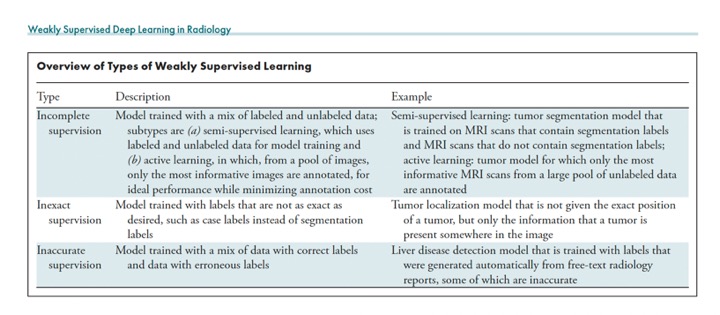
Weakly Supervised Deep Learning in Radiology
Leo Misera • Gustav Müller-Franzes• Daniel Truhn• Jakob Nikolas Kather
Radiology 2024; 312(1):e232085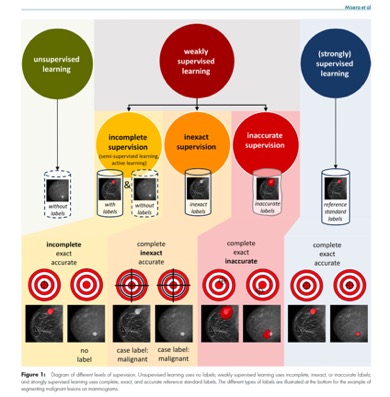
Weakly Supervised Deep Learning in Radiology
Leo Misera • Gustav Müller-Franzes• Daniel Truhn• Jakob Nikolas Kather
Radiology 2024; 312(1):e232085


- “The Surgeon General has identified medical misinformation as a major public health threat, and many professional societies, including the American Medical Association, have called for action to combat it.”
Physicians Spreading Misinformation on Social Media — Do Right and Wrong Answers Still Exist in Medicine?
Richard J. Baron, Yul D. Ejnes
n engl j med 387;1 nejm.org July 7, 2022 - "There aren’t always right answers, but some answers are clearly wrong.”
Physicians Spreading Misinformation on Social Media — Do Right and Wrong Answers Still Exist in Medicine?
Richard J. Baron, Yul D. Ejnes
n engl j med 387;1 nejm.org July 7, 2022 - "Medicine has a truth problem. In the era of social media and heavily politicized science, “truth” is increasingly crowdsourced: if enough people like, share, or choose to believe something, others will accept it as true. This way of determining “truth” doesn’t involve scientific methods; it relies instead on “the wisdom of crowds,” which has particular power in a democratic society in which leaders and policies are chosen by the will of the group. Such choices anchor concepts like freedom and liberty. But they may not be helpful in determining whether a building will collapse, whether your brakes will stop your car — or whether a medication or vaccine works.”
Physicians Spreading Misinformation on Social Media — Do Right and Wrong Answers Still Exist in Medicine?
Richard J. Baron, Yul D. Ejnes
n engl j med 387;1 nejm.org July 7, 2022
- HIPA (Health Insurance Portability and Accountability Act)
HIPAA restrictions on researchers have affected their ability to perform retrospective,
chart-based research as well as their ability to prospectively evaluate patients by contacting
them for follow-up. A study from the University of Michigan demonstrated that
implementation of the HIPAA Privacy rule resulted in a drop from 96% to 34% in the proportion
of follow-up surveys completed by study patients being followed after a heart attack.[35]
Another study, detailing the effects of HIPAA on recruitment for a study on cancer prevention,
demonstrated that HIPAA-mandated changes led to a 73% decrease in patient accrual, a tripling
of time spent recruiting patients, and a tripling of mean recruitment costs. - "Diagnostic confidence and the accuracy of interpretation of volume CT images have increased with improvements in postprocessing techniques."
Volume CT:State of the Art Reporting
Parrish FJ
AJR 2007; 189:528-534 - "The evidence in the literature supports the reporting of volume CT data from thin images with the use of techniques such as MPR, MIP, and volume rendering as additional tools to increase diagnostic confidence and sensitivity."
Volume CT:State of the Art Reporting
Parrish FJ
AJR 2007; 189:528-534 - "Volume CT reporting allows radiologists to produce a few images of the diagnosed pathologic condition in the best orientation and with the most appropriate postprocessing method for referring clinicians."
Volume CT:State of the Art Reporting
Parrish FJ
AJR 2007; 189:528-534 - "The change in reporting techniques from film to manipulation of CT volume data sets requires radiologists to have access to volume reporting stations and the necessary training."
Volume CT:State of the Art Reporting
Parrish FJ
AJR 2007; 189:528-534 - "The change in reporting techniques from film to manipulation of CT volume data sets requires radiologists to have access to volume reporting stations and the necessary training.This access may be the rate limiting step for improvement in the diagnostic accuracy of CT by use of volume reporting and will only be overcome by the action of radiologists."
Volume CT:State of the Art Reporting
Parrish FJ
AJR 2007; 189:528-534 - "This access may be the rate limiting step for improvement in the diagnostic accuracy of CT by use of volume reporting and will only be overcome by the action of radiologists."
Volume CT:State of the Art Reporting
Parrish FJ
AJR 2007; 189:528-534 - Compared with the conventional 2D colonic polyp detection method, primary 3D interpretation with use of virtual dissection software for CT colonography revealed comparable per-polyp (77% and 69% for two readers) and per-patient (77% and 73% for two readers) sensitivities and comparable per-patient specificity (99% and 89% for two readers) for the detection of polyps 6 mm in diameter or larger and involved a shorter interpretation time.
Two versus three dimensional colon evaluation with recently developed virtual dissection software for CT
Kim SH et al.
Radiology 2007 Sep;244(3):852-64 - State of the Art CT: 1990
- 1 second scan times with 4 second interscan delay for a total of 12 scans per minute (non-spiral CT)
- 4 mm/sec table speed, 4 mm collimation, and coverage of 96 mm in a 24 second acquisition (and then reconstruct the data)